Writing Advice: do not take.

Many years ago, a few weeks before a nice long trip to Hawaii, I wrote fifty pages of a novel and sent it off to two publishers. One I can't remember, and one was Charles Scribner's Sons. The reason I remember Scribner is because they had published F. Scott Fitzgerald and Ernest Hemingway--and they answered with a short letter. I submitted just to take the leap, get in the game so to speak. And once in Hawaii, I forgot about it. Weeks later, on my return, I had envelopes from both publishers; back then, they answered more swiftly. Now, they may not answer at all. Anyway, one note was a rejection. The other was from an editor at Scribner who said, (and I am paraphrasing as I no longer have the note) "I enjoyed what I have read of (Forgettable Title) and would like to see more. You have a clever, ironic style--don't lose it. Keep us apprised of your progress." And it was written on fine linen paper of high rag content, with a fountain pen!

vintage_skull_crossed_bones_arsenic_poison_label_postcard-r731c5b82482f40998e0beae12a52ac47_vgbaq_8byvr_512.jpg

Where is that novel, now? I don't know. I immediately went on to other things, job, women, the proper attire for whatever I was at that stage. I never went back to that novel. Why? I'd been validated. Sort of. It was the old "I wouldn't belong to any club that would have me" Woody Allen sort of self esteem trick. Or perhaps The Fear of Success. The wiring. Who knows how it was formed in those early years.

Whatever, I'm making up for lost time these days. Submitting more, writing more, and hopefully, better.

But one bit of advice, if I may: don't discuss your current project. Doing so sucks the energy out of it. And this: don't take my advice or anyone else's.

Some will tell you to write so many words a day. Some will tell you to work in a library. Some will say only work in the dark hours of morning. The key word is work. Work a little. Work a lot. Up to you. But do write.

And some just want to tell you what to do. To them: up ya nose widda rubbah hose.

Wing Walking, Out Bad, and Ayiti.

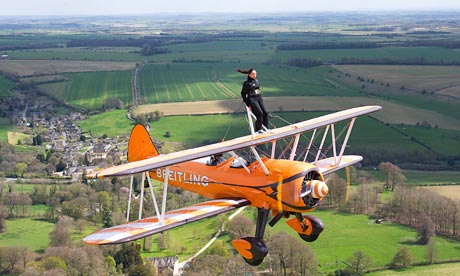
The first short story of 2014 just went out to some top tier literary reviews and already got a rejection! It's about a kid who graduates high school in the 50's and decides to take a year off before college. He spends the summer painting the house and outbuildings of his old man's farm property, and he lives on the farm while doing this. He's paid for this endeavor and he uses the money to soup up a 1942 Ford coupe, starting with a 1957 Canadian truck engine, bored out, Isky cam, etc. It's also the first story in a collection entitled Hot Rods from Hell. The boy, Billy Altair, has a new 33rpm stereo he got for his birthday, but only one record: Victory at Sea, a very symphonic long play album, and it fills the old farmhouse and surrounding environs with big booming music. One day, he sees a colorful biplane buzzing the place, and the story gains momentum. It surprised me, the way this story skidded around some turns and the way it ended, too. It's about 4,500 words and it's called Wing Walker.

Out Bad is a book by Donald Charles Davis http://www.agingrebel.com/ and it is, in a word, electrifying. He rode with the Mongols, a heavy-duty outlaw group in California and other states. It's mainly about the targeting of the Mongols by federal agencies, and its title comes from the ejection of a member by stripping him of patch and privileges and any further association with the club.

It's a self-published book, and it suffers from odd page makeup in places, plenty of typos, and mixup of sentences, but it's a good book through all of that, by a very intelligent author, and may even be an Important Book. Journalist Davis chroncicles the moral, financial and criminal excesses of the undercover agents who penetrated the club.  The flagrant abuse of power and tax-generated money is shocking and disgusting, especially when the targets of that abuse are disenfranchised Americans. Mongols and other clubs are easy marks for the federal agencies that went after them. And the people within those agencies are the ones who could not stand up under harsh investigative procedures themselves--or even fair, unbiased procedures.

Ayiti by Roxane Gay is visceral and eye-opening. Packs a bunch of wallops, and pulls none. The title is the Haitian native pronunciation of Haiti, and however it's pronounced, you will not think of this place of poverty and beauty the same after reading the series of gritty vignettes about explosive anger, pain and the inescapable dogfight of daily existence. She is the author of An Untamed State, available for pre-order on Amazon

Road iron Motorcycle and Book Club Buys Prescott, Arizona

(A deal's a deal. If a Book & Bike club buys your town, accept it.)

Servi_Car_02.JPG

Last night's dream. This kind of outlaw club with a fleet of grey Harley-Davidson Servicycles (the 3-wheelers they used to make to do everything from sell ice cream, to police utility work--tank shift and a box between the rear two wheels) bought a town in Arizona. So they owned it. But the town wouldn't recognize the sale. In my dream, the sale was legal. The only spokesperson for Road Iron was a slim woman with short hair and tattoos, wearing a t-shirt and jeans and high boots that look like horsey-type boots that are usually worn with jodphurs. She was exasperated with the town.

That's about it. No rhyme, no reason. A book & bike club bought a town, and a specific one at that. Prescott exists. I looked it up and it's a town in the middle of Arizona of about 34,000 people. I've never been there, never even heard of it, to my conscious knowledge.

One detail, as the dream fades, is that the club didn't ride these 3-wheeler utility things, they rode choppers like outlaw clubs do. The fleet of Servicycles were parked somewhere near or in Prescott. Waiting to deliver books, maybe. There was noise, chopper sounds, revving, hollering. The lady seemed to be the leader, perturbed that the town didn't recognize the sale. Hey, wouldn't you?

Then I woke up. Piecing it all together, maybe the takeover of Hollister (CA) in 1947 by bikers was the neural input to start this thing; I've read about it lately, in more than one book. The lady looked like someone who used to have a gallery in Paola. But the rest of it is a mystery. Some cultures believe dreams are our real life, and this daily thing we do is but a dream. Somehow, the walls of the corridor we travel waver and become transparent enough to see into a parallel world. And that's a Pandora's box of musings and meanderings.

But when I was twelve I had recurring dreams. The same dream for three or four nights. It involved a reflective pool at dusk with monks moving silently around it, in robes with hoods that hid their faces in shadow. And trees outside of that, tall slim trees like columnar evergreens. There was nothing scary about this, to my twelve-year-old mind, but it was peaceful. It turns out a great-uncle died during that period, an artist, Jack Gage Stark, and the scene turned out to be in Santa Barbara--I saw it in a book years later. Jack lived in Santa Barbara, and was associated with that scene. But that's another story, another dreamscape. Kind of a remote viewing, if you will. Perhaps Prescott will reveal itself someday. 

Fat men in Speedos, Dylan Thomas and Ski No More, My Darlin'

The-poet-an--unlikely-ico-010.jpg

The wife is stuck in Detroit, visiting kds with her mom. They were to fly out tonight, Sunday, but no deal. Massive snowstorm. Where are the fat ruddy guys in their abbreviated swimsuits standing around some ice-hole in Jesus Freezus, ND? The Polar Bear Club in NY swam at Coney Island a couple days ago in 41 degree water. Sounds almost warm. Women in bikinis. Plenty of guys, but no Speedos that I saw. 2,500 people made the splash. And that's all the enthusiasm I can dredge up for that.

Dylan Thomas is more like it. Poet-genius. His words, the way he coupled them and played them, are magical. He died too soon, as we like to say, but what does that mean? He was here, he was a giant, his words are here for us any time we wish. Before he went away, he wrote A Child's Christmas in Wales. Wrote it, I believe, for Ladies Home Journal, but it achieved a more robust life of its own and became a classic. It's what the literati refer to as "accessible."

It begins, "One Christmas was so much like another, in those years around the sea-town corner now and out of all sound except the distant speaking of the voices I sometimes hear a moment before sleep, that I can never remember whether it snowed for six days and six nights when I was twelve, or whether it snowed for twelve days and twelve nights when I was six."

He goes on to talk of a wool-white bell-tongued ball of holidays resting at the rim of the carol-singing sea, and launches into the tall tales and the mystery magic of the season for a six year old, or twelve year old.

You can buy the slim book or, much better yet, listen to the 20-minute CD, spoken by the man his own self. You'll never forget it. And it'll help brighten this month of January, and Christmases for years to come.

Skiing. For years I was drunk on skiing, addicted to it. I lived in flat-ass Omaha, but went to Colorado every chance I got and for as long each time as I could stay without loss of job and perspective, though both suffered. Near Omaha was (and still is, I hear) a ski-hill, Crescent, in Iowa, and several of us were there every night it was open. The runs had been designed and laid out by the legendary Stein Eriksen, who I met in Aspen, when I was trying to figure out a way to stay there. The only job available was apprentice to a farrier, and I considered it. I wonder where I'd be now, had I done that. Forks in the road, man.

Last month I got a cortisone shot in my right knee, for excruciating pain, and remembered wrenching that knee on the expert runs of Ajax Mountain in Aspen. Half a century ago. But we're indestructible at that age, and I just taped it up and continued. Ajax is now Aspen Mountain, though I prefer its earlier name, the badass warrior in Homer's Illiad. Wonder why they changed it. Anyway, I had no style, just speed, and I rented skis and boots, haunted the slopes where classes were held, at a distance, listening to the instructors' shouted directions, until they'd run me off. But I learned.

Later, I bought Head Vectors, much longer than skis of today, with long-thongs and beartrap bindings, then better bindings as they came along. Learning to ski on long skis (how you measured your proper length was to stand straight, raise your arm straight up, and the tip of the ski should touch your wrist below the ball of your thumb) will prepare one for even greater control with shorter skis. And as the years went by, the skis got a bit shorter, and the releases got less vicious.

My first pair of Heads were ruined rope-skiing behind a Jeep on Omaha streets from bar to bar, a kind of pub-ski that a bunch of us dreamed up. The snow was deep, but some city jokers laid down cinders and that's just hell on skis, whatever your wax.

In Aspen and Vail and Copper Mountain and a dozen other joints, even at Crescent and little hills in Illinois and Wisconsin, wherever I was living, the food tasted better and the drinks were fantastic when skiing was involved. Nothing like skiing behind a horse after taking on a cargo of gin & tonics, then swinging out around the horse, watching his eyes bug out as you pass him, and whoever's aboard him trying to keep him from bucking...then it happens: bam, you hit a small tree buried in the snow and go clattering ass over teakettle, skis windmilling right along, bippity bip, digging divots.

We skiid behind horses, pickups, snowmobiles, in pastures and city parks and downhill in the ski areas and anywhere we could. Once, I spent more than three weeks in Aspen, and the mayor's dog was a constant companion, slept in my room at night sometimes, lay at my feet at the Chart House. The mayor was Guido Meyer, mayor from 1973 to 1979. I stayed at his chalet/motel, nice place, and he was a super nice guy. I had fallen into the rhythms of the town, and hated to leave. I plotted over the following year to find a way to stay there, summer and winter, but to no avail. I never met Hunter Thompson, that was the problem. Had our paths crossed, I'd have stayed.

Tomorrow: notes from my ski days, unabridged. They read like downhill racing, and downhill was a life description at that time.